FEATURE
Accelerating Collaborative Sustainability in the Tapes Industry
PTFE Coated Fiberglass Tape for Industrial Heat-Sealing Applications
Opportunities to increase market share will increase when companies are pre-positioned for growth in a resilient and scalable way.
PTFE Coated Fiberglass Tape for Industrial Heat-Sealing Applications
By Lisa Anderson, Founder and President, LMA Consulting Group
By Brian Asik, SVP, Custom Fabricating & Supplies, Franklin, Wisconsin
Proper tape selection and maintenance help to maximize performance in heat-sealing systems.
PTFE-coated fiberglass tape — commonly known under the Teflon™ name — is engineered for industrial environments that demand high heat resistance, clean release, and dimensional stability. Constructed from a woven fiberglass substrate and impregnated with a heavy coating of PTFE (polytetrafluoroethylene), this tape combines structural strength with a smooth, non-stick surface that performs reliably under extreme conditions.
The fiberglass backing provides excellent tensile strength — the amount of pulling force a material can withstand before it breaks or permanently stretches — and dimensional stability, preventing shrinking, strain, or distortion during continuous exposure to temperatures up to 500 °F (260 °C). This stability is critical in heat-sealing environments, where even slight movement or deformation can compromise seal integrity. The high PTFE content delivers superior release properties, allowing molten plastics — such as polyethylene, polypropylene, and other thermoplastics — to separate cleanly from heated surfaces without sticking or tearing.
The tape's non-toxic, odorless, and tasteless properties make it suitable for use in food processing and packaging environments, where material safety and cleanliness are paramount.
In addition to its thermal and release performance, the tape has a silicone adhesive backing designed for high-temperature applications. This adhesive offers strong, consistent bonding to metal surfaces while maintaining flexibility and chemical resistance. It also enables clean removal, reducing residue and simplifying maintenance during tape changeovers. The result is a product that not only performs under stress but also supports efficient, low-maintenance operations.
Beyond its core construction, PTFE-coated fiberglass tape also offers excellent dielectric strength, making it suitable for applications where electrical insulation is required alongside heat resistance. Its slick, non-stick surface helps materials move smoothly through machines, reducing resistance and keeping high-speed production running efficiently.
Industrial Applications
One of the primary uses for PTFE-coated fiberglass tape is for heat-sealing equipment. Applied to heating elements, sealing bars, jaws, and impulse wires, the tape prevents molten plastic and film from adhering to hot surfaces. This non-stick barrier is essential for maintaining consistent seal quality, especially in packaging operations where precision and repeatability are critical.
By minimizing material buildup, the tape reduces the need for frequent cleaning and helps prevent defects such as incomplete seals, burn-through, or contamination. This directly translates to less downtime, improved productivity, and longer equipment life. In high-volume operations, even small improvements in uptime and consistency can have a significant impact on overall efficiency.
The tape's non-toxic, odorless, and tasteless properties make it suitable for use in food processing and packaging environments, where material safety and cleanliness are paramount. It is commonly used in bagging systems, shrink wrap equipment, and vacuum sealing machines. Additional applications include plastic processing, composite manufacturing, and conveyor systems, where high heat and release performance are required.
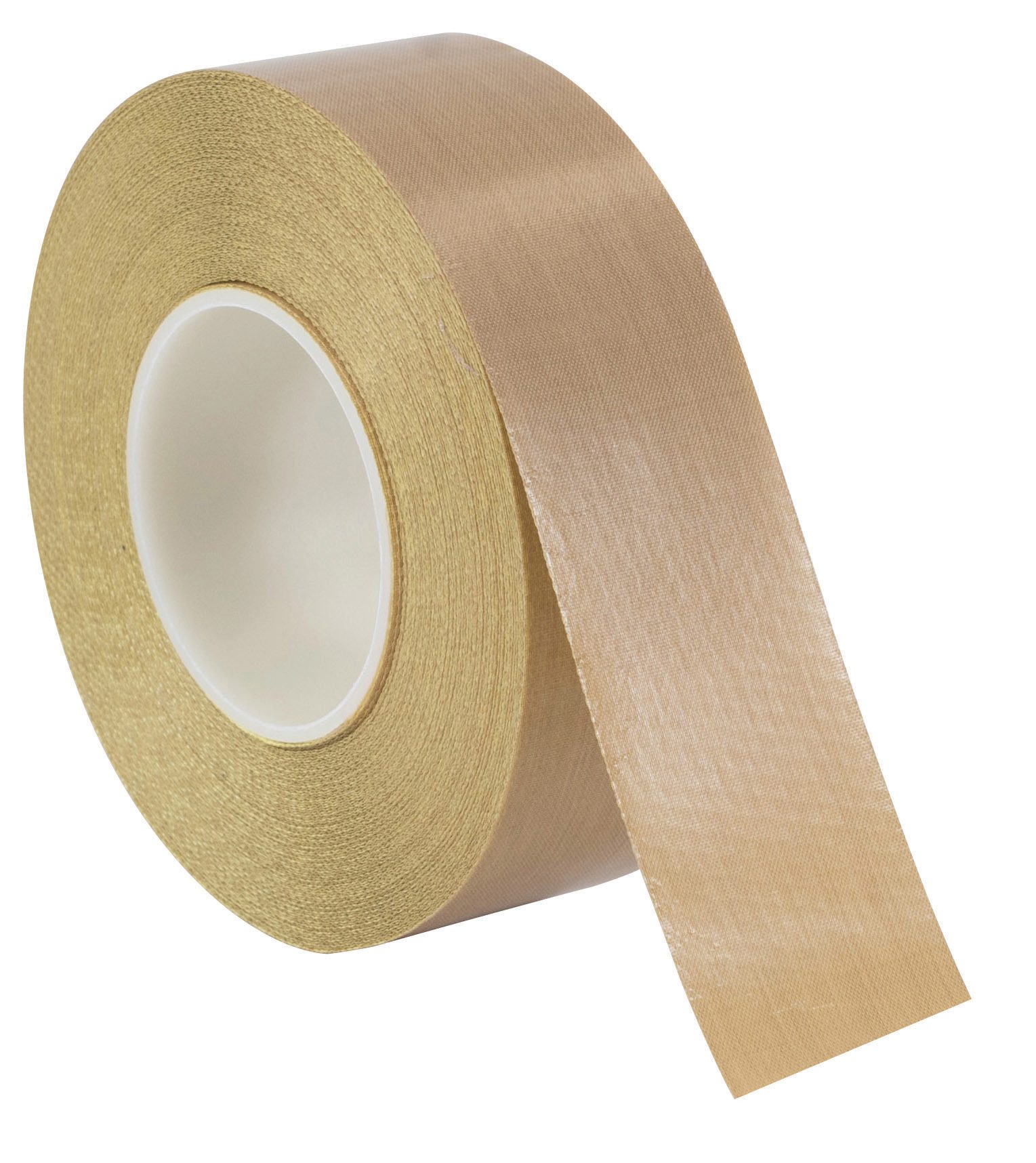
PTFE tape on a liner. Image courtesy of Custom Fabricating & Supplies.
Choosing the Right Width
When it comes to heat-sealing performance, tape width plays a critical role. Each width serves a specific function, and selecting the right configuration — or combining multiple widths — can optimize both performance and durability. Understanding how to use ½”, ¾”, and 2” PTFE tape allows operators to maintain consistent seals, reduce wear on components, and extend maintenance intervals.
½” PTFE Coated Tape
This narrower tape serves two key roles in heat-sealing applications. On manual impulse sealers, it is placed beneath the sealing wire to prevent direct contact with the metal frame, protecting both the wire and the equipment. In high-speed machines, it is often layered over a wider PTFE strip to provide targeted reinforcement in high-wear areas. Typically thicker than wider tapes, the ½” option delivers enhanced durability where heat and pressure are most concentrated.
¾” PTFE Coated Tape
Commonly used on I-bar and L-bar sealers, ¾” PTFE tape is applied directly over the sealing wire to prevent film residue buildup. Over time, adhesives and plastic materials can accumulate on exposed wires, leading to inconsistent seals and reduced efficiency. This tape acts as a protective barrier, preserving wire performance. Routine replacement — before the tape wears — is essential and can significantly extend sealing wire life while maintaining optimal seal quality.
2” PTFE Coated Tape
The 2” width is ideal as a base layer in both manual and automated sealing systems. It is typically applied to sealing bars, jaws, or bumpers that come into direct contact with heat. This broader coverage protects equipment from wear, heat damage, and material adhesion. For added durability, a narrower ½” tape can be layered on top, creating a multi-layer protection system. This approach allows operators to replace the top layer more frequently without disturbing the base layer, reducing downtime, and improving maintenance efficiency.
Best Practices for Performance and Longevity
To get the most out of PTFE-coated fiberglass tape, proper installation and maintenance are essential. Surfaces should be thoroughly cleaned prior to application to ensure strong adhesion and prevent premature lifting. The tape should be applied smoothly, without wrinkles or air pockets, to maintain even heat distribution across the sealing surface.
Consistent seals start with a clean, stable surface — PTFE tape helps maintain both.
Regular inspection is equally important. Signs of wear — such as discoloration, fraying, or adhesive breakdown — indicate it is time for replacement. Waiting too long can lead to tape failure, exposing underlying components to damage and potentially causing costly downtime. Establishing a defined replacement schedule helps maintain consistent performance and extends the life of both the tape and the equipment.
Origin of PTFE
PTFE itself was accidentally discovered in 1938 by Roy J. Plunkett, a chemist working for DuPont. While experimenting with refrigerant gases, he found that tetrafluoroethylene had polymerized into a white, waxy solid — what we now recognize as PTFE.
This material was later commercialized under the Teflon brand and became widely known for its non-stick, heat-resistant, and low-friction properties. Over time, manufacturers adapted PTFE into various forms — including coated fabrics and adhesive tapes — to meet the needs of industrial applications.
While PTFE tape itself was not invented by a single individual, it evolved as industries recognized the value of combining PTFE with substrates like fiberglass to create durable, high-performance materials. Today, PTFE-coated fiberglass tape remains a critical solution in heat sealing and high-temperature processing, delivering reliability in even the most demanding environments.
Learn more about Custom Fabricating & Supplies by visiting www.customfabricate.com.
Opening image courtesy of Custom Fabricating & Supplies.