FEATURE
Accelerating Collaborative Sustainability in the Tapes Industry
Rethinking Masking Tape in Transportation: Why Tape system engineering matters more than thickness
Opportunities to increase market share will increase when companies are pre-positioned for growth in a resilient and scalable way.
Rethinking Masking Tape in Transportation: Why Backing Matters More Than Thickness
By Lisa Anderson, Founder and President, LMA Consulting Group
By Cindy Stoner, Vice President, Vibac Americas, Bay St Louis, Mississippi.
Legacy specifications built around thickness and high-temperature adhesives are giving way to integrated tape designs developed to meet the requirements of modern coating processes and improved operational efficiency.
For decades, the transportation industry — automotive OEM, collision repair, aerospace, marine, bus and truck builders, RV manufacturers, and boat builders — has relied on thickness-driven masking tape specifications, often exceeding 7 mil, under the assumption that more material equates to better performance.
At Vibac Group, a vertically integrated and family-owned manufacturer of pressure-sensitive tapes, this assumption has long been challenged through a different approach — one focused on engineering the tape structure as a whole, where backing, saturation, and adhesive formulation are designed to function as an integrated system.
But transportation environments are now exposing the same reality more broadly. From automotive OEM paint lines to collision-repair shops, from aircraft manufacturing to boat building, masking tape performance is not defined by thickness only — it is defined by how effectively the tape construction performs within a specific application process.
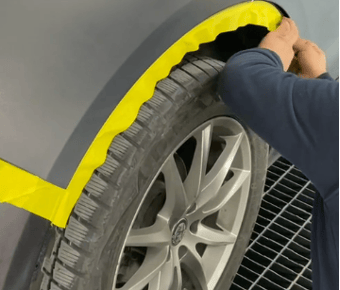
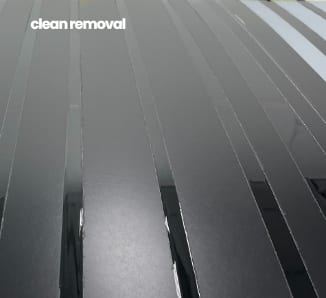
Myth: Thicker Equals Better Performance | Reality: Performance Depends on Tape System Design and Material Balance
Masking in transportation demands clean edges, conformability, and consistency under real-world conditions such as heat, curvature, and dwell time. Boat builders face challenges with gel coats and adhesion to semi-permanent release agents. Despite this complexity, the industry promotes a simplified idea: one tape fits all. In reality, this leads to compromise, rework, and inefficiency.
Thickness and high-temperature adhesive systems — often exceeding 7 mil — were designed for older coating technologies. Modern systems no longer require this approach, yet specifications remain unchanged. In many cases, 7 mil constructions and high-temperature adhesives are solving yesterday's problems — not today's.
7 Mil Plus High-Temperature Adhesive Equals Legacy Specification
Most manufacturers source from the same suppliers, which can limit control over structure and performance. Backing plays a critical role within the overall tape construction, influencing adhesion, conformability, bleed resistance, and edge definition. However, these properties are not determined by the backing alone, but by the interaction between backing structure, saturation processes, and adhesive formulation. Transportation environments expose these weaknesses. Thicker tapes struggle on curves, in heat, and in precision applications, as increased thickness can reduce conformability, limit elongation, and create higher edge profiles that can lead to paint build-up and less defined lines. In transportation applications, performance is better achieved through a tape engineered as a balanced system, where backing, saturation, and adhesive formulation are optimized to ensure smooth conformability on complex surfaces, controlled adhesion for clean removal without residue, ease of application during masking operations, and high edge precision for sharp and consistent paint lines.
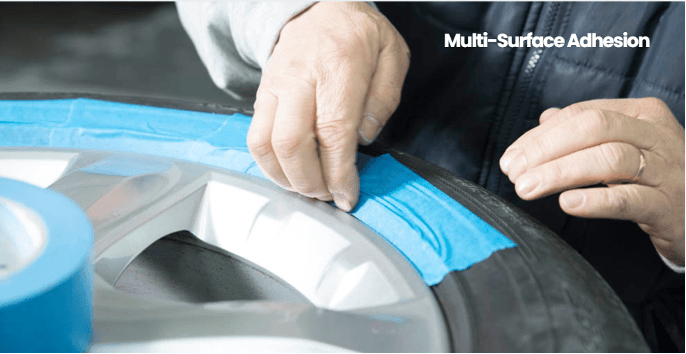
Vibac takes a different approach by controlling key elements of tape construction at the source — from backing production and saturation processes to adhesive development — enabling a higher level of consistency and performance control. Founded in 1968 and still family-owned, Vibac reflects an Italian philosophy of precision and control. With vertical integration including its own paper mill, Vibac controls performance from the ground up. The company is expanding in North America, with plans for an operation in Tennessee. Sustainability is achieved through efficiency — less material, less waste, and better performance.

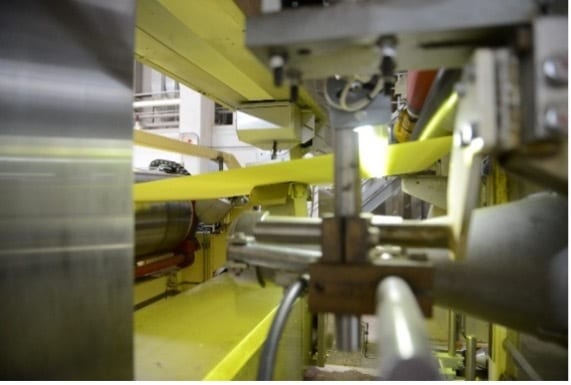
For more than a decade, the crepe paper masking tape category has seen little meaningful change. Even the last widely recognized shift around 2010 did not address the core issue. What followed were process-driven adjustments that delivered only marginal performance improvements, often at a significantly higher cost. The next step-change won't come from adding more — it will come from rethinking what's underneath. The future of masking tape is not defined by increased thickness, but by the optimization of material structure, formulation, and process design. At Vibac, that shift is already in motion.
Learn more about Vibac by visiting www.vibac.it/en.
Opening image courtesy of ugurhan / E+ / Getty Images.