FEATURE
Accelerating Collaborative Sustainability in the Tapes Industry
Functional Adhesives: Sustainable Innovation for an Evolving Industry
Opportunities to increase market share will increase when companies are pre-positioned for growth in a resilient and scalable way.
Functional Adhesives: Sustainable Innovation for an Evolving Industry
By Lisa Anderson, Founder and President, LMA Consulting Group
By Víctor Sobrino Bastán, Researcher in Coatings, Adhesives and Converting, AIMPLAS
These adhesives bond substrates and provide added properties that enhance the functionality of the final product.
Adhesives have undergone significant evolution in recent years, positioning themselves as advanced — and in some cases, substitute — alternatives to traditional joining methods such as mechanical fasteners or welding. This shift has been driven by R&D efforts focused on developing tailored solutions capable of meeting the increasing demands of various industrial sectors.
In this context, functional adhesives represent a qualitative leap forward. These materials not only bond substrates but also provide added properties that enhance the functionality of the final product. There are formulations with antimicrobial properties, ideal for sectors such as food and healthcare; UV-curable adhesives that enable fast and precise bonding; de-laminable adhesives activated by stimuli such as heat or light, facilitating the recycling of components; barrier-effect adhesives that protect against gases like oxygen and water vapor, essential for smart packaging; and even conductive adhesives that replace soldering in miniaturized electronic devices.
In a global scenario where sustainability and efficiency are strategic priorities, these materials contribute to lighter structures, reduced energy consumption during manufacturing, and the integration of advanced functionalities. Sectors such as food packaging, automotive, electronics, and aerospace are already incorporating these technologies into the design of lighter, more durable, and environmentally friendly products.
This trend signals a profound shift in industrial approaches towards smarter, more sustainable, and customized solutions. Functional adhesives are thus emerging as key enablers in the transition towards advanced and responsible manufacturing.
Circular Adhesion
Aware of the need to develop adhesives that are increasingly efficient and environmentally respectful, AIMPLAS has been actively involved in various projects aimed at improving adhesive technologies. These innovation efforts focus on both functionality and sustainability, addressing real needs within the industrial landscape:
- PERCAL: This project successfully valorized urban organic waste to obtain intermediate chemical compounds of industrial interest, which were used as the basis for formulating hot-melt adhesives, promoting a circular economy.
- ADHBIO: Development of a biodegradable and compostable hot-melt adhesive with over 95% renewable polymer content. This adhesive is compatible with industrial composting processes, offering a sustainable alternative to conventional adhesives.
- ECOGLUE I & II (in collaboration with INESCOP): Development of eco-friendly, detachable adhesives for sectors such as footwear, construction, and transport. These adhesives allow "on-demand" separation of bonded components, facilitating product disassembly and recycling at end-of-life.
READY RECYCLE
Building on its accumulated experience and firm commitment to sustainability and technological innovation, AIMPLAS is participating in the READY RECYCLE project under the CDTI Innovation program. The project aims to develop adhesive formulations with barrier properties and controlled delamination capability to facilitate the recyclability of multilayer structures.
The main objective is to create functional adhesives that, in addition to offering barrier properties, can be delaminated through the application of heat. This approach will enable the separation of layers in multilayer packaging, improving the recyclability of components and reducing the environmental impact of plastic waste.
READY RECYCLE involves the development of advanced formulations through two complementary technological lines:
- Polymers of natural origin: Biodegradable materials capable of dissolving in hot water, allowing controlled removal under specific conditions.
- Polymers with intrinsic barrier properties: Materials offering excellent resistance to gas transmission, crucial for preserving food and sensitive products.
This new approach will enable the design of multilayer packaging with advanced technical properties without compromising recyclability, in line with European directives and circular economy principles. It also responds to growing industrial demand for environmentally friendly materials without sacrificing functionality or production efficiency.
Experimental Development
The development of functional adhesives within the READY RECYCLE project includes an experimental phase structured in two complementary stages:
- Laboratory Scale: Reversible adhesives with barrier properties will be formulated and evaluated for key parameters such as processability, substrate compatibility, adhesion, viscosity, and oxygen barrier performance.
- Pilot Plant Scale-Up: A crucial step to validate the process at industrial level. Semi-industrial lamination technologies will be used to replicate real application conditions and assess adhesive performance in production contexts.
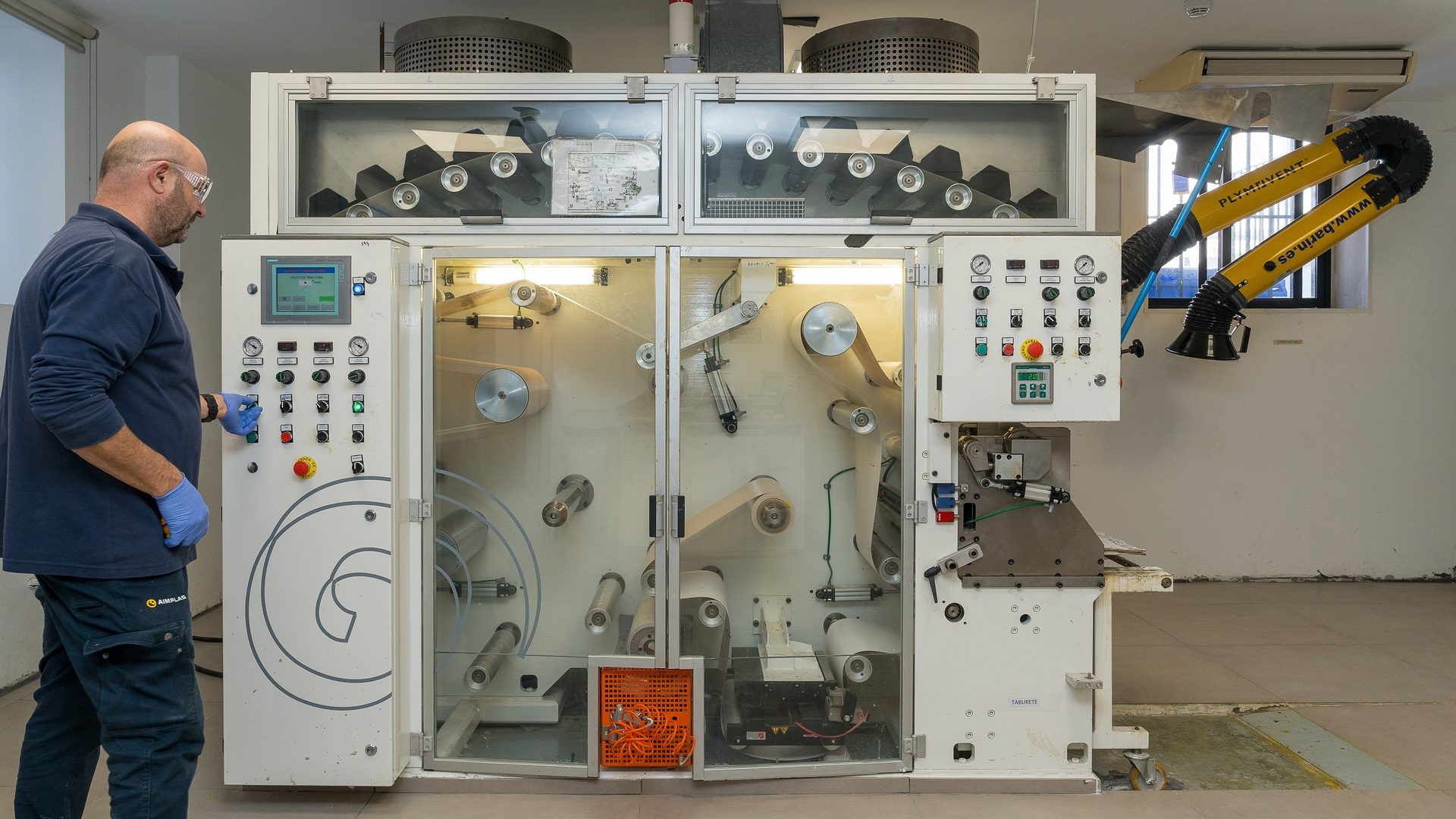
Image 1: Pilot-scale laminator.
During this phase, the reversibility of the adhesive will also be evaluated under conditions similar to industrial recycling processes, to verify its delamination capability.
Through this approach, READY RECYCLE strengthens AIMPLAS's position in the development of advanced adhesive solutions, demonstrating that sustainability and innovation can progress hand in hand towards a more responsible, efficient, and circular industrial future.
Learn more about AIMPLAS at aimplas.es.
Images provided courtesy of AIMPLAS.